WA Secretary of State Blogs

Spooky Spokane Falls Enjoys the Luxury of a Haunted House

May 16th, 2013 Matthew Roach Posted in Articles, Digital Collections, For the Public, Random News from the Newspapers on Microfilm Collection, State Library Collections 1 Comment »

Haunted 5

From the desk of Steve Willis, Central Library Services Program Manager of the Washington State Library:
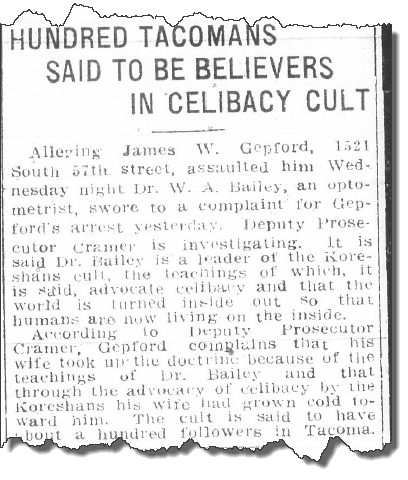
Three mysteries emerge from an episode back when Spokane was known as Spokane Falls, one of them concerns a ghost, another is geographic, and the last is bibliographic. No, I’m not talking about a spirit scouring the online catalog– that is called BOOlean searching (heh-heh, get it?). This series of questions emerge from the following article in the Spokane Falls Review, March 21, 1885:

SPOOKS

Spokane Falls Enjoys the Luxury of a Haunted House.

“Among the other many attractions in and about Spokane Falls, there has recently been added that of a haunted house, wherein the cheerful disembodied spirit holds high carnival, and the spectral inhabitants of the silent and bewitching midnight meet together to join in ghostly orgies, talk politics and frighten the timid denizens of this mundane sphere out of their seven senses. Belated pedestrians, with a tendency to scare easily, shun the side of street upon which is located the trysting place of the jovial spooks, while the more courageous have marched up to the premises, but, if not really frightened, have had no hesitancy in moving off at a speed above that of ordinary promenading when having their ears saluted with uncanny sounds.”

“The building that has been taken without the formality of lease, by these airy nocturnal roysters, is the old Phoenix beer hall that was the scene of a sad chapter in the city’s history; that of the unprovoked murder of a young man last summer, and which has been unoccupied for several months. We have heard vague rumors of the presence of a ghost, but have, so far, been unable to see anyone who will admit of having seen anything of a supernatural agency. Although the belief is so strong that the unexplainable exists that it is not every one you meet who will volunteer to take his blankets and camp in the room overnight.”

“It is said that on a certain occasion, recently, a man passing had his attention attracted by a strange noise that seemed Haunted 3to proceed from the room, and, going carefully up the alley, he peered into a window. He didn’t remain rooted to the spot. His legs refused to allow his body to remain in the neighborhood and he don’t remember just how he soon did get to bed, but it was only a small fraction of time after taking one gaze, when he had his head buried under the blankets.”

“He touches the subject tenderly and has kept much more rational hours ever since. What he saw could not have grown out of the character of the fluid he had been drinking, as he had religiously stuck to water that evening. To a limited few, he claims that when he reached the window he saw the shadowy outlines of a man that shone out with a phosphorous light. The shadowy tenant was walking with his back to the window and was giving vent to a noise sounding as though he was in a good deal of pain or was growling over the chilliness of the night. When the apparition turned about and headed for the window, one glance was sufficient for the individual. Considering that the specter would consider it an indelicate intrusion, the witness adjourned without apology. He calculates that, with ordinary luck, he will be able to outlive the sensation he experienced in fifty or one hundred years.”

“Making all due allowance for a vivid imagination and a bristly fright, there is still left a margin for the belief that the visitor from the other world is not a party that the average man would choose for a boon companion.”

“Since then, and perhaps before (although we have no data for going behind the returns) attention has been attracted to the spot by divers unpleasant sounds, as if a whole colony of the defunct were occasionally congregated for a jubilee. No thorough investigation has, so far, been made, as the initiated have perhaps felt a slight delicacy in forcing their presence in company where they were not invited. We suppose that in time, when the thing becomes shorn of the glamour of freshness, some one will want to deprive the public of the benefit of such an important tributary to the popularity of the Falls, and try to clear up the mystery.”

Haunted 4“We cannot say when the boss spook holds his receptions, but if any one is curious he can hang around o’ nights and find out for himself. We are not paid for keeping a reporter on the spot.”

Mystery # 1: What the heck is it? In all my perusing through territorial newspapers, this is the most detailed and open account I have found describing public “ghostly” happenings.

Mystery # 2: The exact location of the Phoenix Beer Hall, which was designated as the HQ for these ghosts, is not easy to find. Apparently closed by 1885, it doesn’t show up on directories or Sanborn maps of the era. I’d be curious to know if that location has experienced other “supernatural” events in the 20th-21st centuries. But where was/is it?

Mystery # 3: In an attempt to find an account of the “sad chapter in the city’s history,” it was discovered the incident was the September 27, 1884 shooting of a quiet carpenter named Henry R. Roblin by John “Jack” Connerry, “a notorious rustler.” Apparently Roblin accidentally bumped into Connerry on a Saturday near midnight at the Phoenix Beer Hall, and that alone sparked the shooting. Connerry was captured the next morning but was moved from Spokane Falls city jail to Cheney as he was in very real danger of being lynched by an angry mob. It seems Connerry escaped jail in Cheney a short time later.

But here’s the mystery. In an effort to find a local article about this shooting, every single newspaper run we have in the Spokane area is missing the issue that would have covered this news. It’s like we have a nice complete set– except for this one period. Every one of them! What’s the deal here? I had to go to newspapers in California and Montana to get the details. Was the episode so shameful no one wanted to preserve the newspapers, or instead did they keep it as a souvenir? In any case, it is quite odd.

The Spokane Falls Review is one the historical newspapers digitized by the Washington State Library. The above article, and many other lively stories about Spokane can be viewed online on the WSL website.


AddThis Social Bookmark Button

Zillah’s Choice, Whisky or a Library?

May 10th, 2013 Matthew Roach Posted in Articles, Digital Collections, For the Public, Random News from the Newspapers on Microfilm Collection, State Library Collections, Technology and Resources No Comments »

Zillah 2From the desk of Steve Willis, Central Library Services Program Manager of the Washington State Library:

When the Washington Irrigation Company attempted to perform a little social engineering in the community of Zillah in an effort to close the saloon, the cause of alcohol found an unlikely champion. The story is told in the Feb. 20, 1903 issue of the Yakima Republic:

IS A DEFENDER OF BOOZE

 A Zillah Minister Who Stands Up For Good Whisky, But Not For Bad

“A minister at Zillah last Sunday night created something of a sensation in his pulpit, according to a resident of that little town who was here this week, when he declared that he occasionally took a drink himself, and that inasmuch as men would get whisky anyway if they wanted it, there wasn’t much harm in giving them facilities for getting good whisky.”

“The Washington Irrigation company has offered to set apart $1400 worth of its justly celebrated Sunnyside land for the endowment of a library at Zillah if the people of that place will cut out the saloon which has been in operation there and which has been a bone of contention among the inhabitants each year.”

Zillah 4

“Commenting upon this proposition, the minister referred to is said to have taken a stand in favor of the saloon as against the library; and to have asserted that if he wanted to he took a drink of whisky, and preferred good whisky.”

“This unexpected deliverance by a minister of the gospel has furnished a valuable topic of conversation at Zillah this week.”

“The Zillah man who mentioned the matter to the Republic stated that it is as yet undetermined whether the people down Zillah 3there will favor licensing the saloon for another year. Recently the proprietor, Correll, hurt himself quite severely, and his bad luck has created some sympathy for him.”

The Washington Irrigation Company’s place in the history of the area can be found in The Victory of National Irrigation in the Yakima Valley, 1902-1906.

It appears Zillah did not get a library until Prohibition took effect. Meanwhile, in recent history another church in the town has made the news. In order to  publicize the name, the Church of God – Zillah constructed a wire sculpture of the famous Japanese movie monster outside the building.

AddThis Social Bookmark Button

Comedy Works in Threes

May 2nd, 2013 Matthew Roach Posted in Articles, Digital Collections, For the Public, Random News from the Newspapers on Microfilm Collection, State Library Collections 1 Comment »

Portrait of Schlumpf from The Cartoon : a Reference Book of Seattle’s Successful Men (1911)

Portrait of Schlumpf from The Cartoon : a Reference Book of Seattle’s Successful Men (1911)

From the desk of Steve Willis, Central Library Services Program Manager of the Washington State Library:

Somewhere long ago I read a quote from the late great Larry Fine, the “Stooge in the Middle” of the always underestimated Three Stooges. He said something to the effect that real comedy always works in threes. Either in timing, or in personalities. Library cataloger’s note: I wonder if this where the AACR2 “rule of three” came from– a Stooges fan in the rulemaking woodwork?

Anyway.

The following story is certainly a candidate for Larry Fine’s Rule of Three. In fact, one figure in this story is even called an “amateur comedian.” The microfilm reel grabbed at random this week unearthed this story from The Seattle Daily Times, Feb. 2, 1907:

JOHN ANDREW NINK ARRESTED

Well-Known Character’s Attempt to Whip Joe Schlumpf Ends Disastrously for Himself and Ally, Matt Dee.

Latter Offered $20 to Pummel the Cigar Merchant and Lands on His Head in the Middle of the Sidewalk.

“John Andrew Nink, for many years a familiar figure on the streets of Seattle, faultlessly dressed in silk hat and fashionable black clothing, a striking contrast to his snow white hair and mustache, spent the greater part of last night in the receiving cell of the city jail, all because he wanted to whip Joe Schlumpf, the cigar merchant.”

“John Andrew Nink, a good judge of beer, a gentleman of leisure and a man with a notoriety that many persons would not be fond of, was shocked when Jailer John Corbett began to search him, just as he would any other prisoner.”

“‘Why, it’s an outrage,’ declared the gentlemanly John Andrew Nink. ‘I’ll not stand for it. I’ve got enough money to buy you all and sell you again. Lock me up in jail? Well, I guess not.’”

“‘If you’ve got $20 bail money to insure your appearance in court to answer a charge of being drunk and disorderly, I’ll let schlumpf 2you go,’ replied Capt. Laubscher.”

“John Andrew Nink couldn’t raise the $20, although he dug deep into his broad trousers. Against his protestations and weak resistance, Jailer Corbett led him off to the receiving cell. All night long he paced up and down the cell while the hoboes guyed him about his tall hat which he refused to remove. At 8 o’clock this morning he was allowed to telephone to a well known woman who said she would send up the money for his bail.”

Hires Man to Whip Schlumpf.

“The gentleman prisoner had a grievance against Joe Schlumpf. He wanted to whip Joe but the big German cigar merchant looked too stately for Nink. He believed in nerving himself and therefore took on a few glasses of tonic. Then he met Matt Dee, a West Seattle man, who has figured in more rows in the last few years than he has fingers and toes. Nink told Dee his troubles. Dee sympathized with him and offered to help him.”

“‘I’ll give you $20 if you’ll whip Schlumpf for me,’ said Nink.”

“Matt Dee used to have plenty of money and there was a time when $20 wouldn’t tempt him, but when he saw $20 coming so easily he took up the proposition. Nink and Dee had a few more drinks and Dee started for Joe Sclumpf’s cigar store in the Butler Block.”

“‘What you been a doin’ to Nink?’ angrily demanded Matt Dee of Joe Schlumpf.”

“There was no answer. Dee looked at Joe and Joe looked at Dee.”

“‘Well, I’ve come over here to give you a lickin’,’ said Dee as he started for the show case.”Schlumpf 3

“Joe stepped from behind his cigar case and with a stiff right-hander he landed on Dee’s jaw and sent him sprawling to the floor. A kick or so landed Dee in the middle of the sidewalk and Joe Schlumpf went back to the case where he finished telling a friend one of his German stories, just as if nothing had happened.”

“Dee hunted up Nink and told him what he had got.”

“‘You’re not game,’ said Nink to Dee. ‘I’ll go over there and wallop that Dutchman myself.’”

“Nink started across the street, followed closely by Dee. The latter, however, decided to wait on the outside. Nink entered the cigar store and big Joe Schlumpf saw him coming.”

“‘Back for trouble, are you?’ yelled Joe, who by that time had decided that he was tired of Nink and his trouble.”

“‘Yes, I’m back and we’ll settle it right here.’”

“Nink started for Joe, but the amateur comedian was too quick for the angry man, and slapping him not ungently on the side of the cheek he sent Nink to the mat, then pushed him out of the door with his No. 12 foot.”

“Nink and Dee had another consultation but they agreed that no more attacks would be made. Nink said goodbye to Dee and the latter wandered up the street. Nink’s humor was not improved and he went deeper into the cups in a nearby saloon, saying he had a gun and was going to get somebody.”

“Not desiring any bloodshed in the thirst emporium, a bartender was sent out for an officer. Patrolman Charles Dolphin responded. He asked Nink if he had a gun. The latter replied that he had not but if he had one he would use it right there.”

“Unawed by the tall silk hat and the fine clothes of Nink, Officer Dolphin put a firm hand on his shoulder and told him he was under arrest.”

Gay With a Policeman.

“‘Are you a policeman?’ asked Nink, who was probably unable to see Dolphin’s uniform and his star.”

“‘Well, I make a noise like one,’ responded Dolphin.”

“There was no more parleying. A wagon call was sent in and Nink went to jail in the private conveyance furnished at the expense of the city.”

“About four years ago Nink was shot in the back while walking along Second Avenue near Union Street. For weeks he was in the hospital and for a time it was thought he would die. It was ascertained beyond all question that a young man had shot Nink because the latter had interfered in family affairs. Nink refused to prosecute and no arrest was made.”

“Nink says he is an insurance agent, but so far as the police know he has not increased business perceptibly in Seattle.”

High-1908JoeSchlumpf

“Joe Schlumpf’s ‘Webster’s’ Amateur Champions of the State of Washington. Season of 1908.” Schlumpf himself is possibly the man standing on the far right. Photo courtesy of Northwest sports historian David Eskenazi.

Nink had a knack for getting into trouble. A few years before the above incident, on an evening in November 1903 indowntown Seattle, he was shot in the back apparently by someone who objected to the romantic overtures Nink was bestowing upon a wealthy widow. A Morning Olympian (Nov. 13, 1903) account of the shooting described Nink as “a well known character in the city [Seattle]. He always dresses well and for years has worn a silk hat, which made him quite a prominent figure on the street.”

Nink died in Seattle Jan. 22, 1917 at the age of 65.

Mark “Matt” Dee, born in New York, raised in Boston, and sent to Ireland for his schooling always said he came home to the U.S. not with an education but “returned with a brogue only.” At age 12 he went to sea, and claimed that at some vague date he married the actress and early film star Blanche Walsh (1873-1915), an assertion that cannot be verified by any source except Dee himself.

Dee also included being the manager of boxer John L. Sullivan (1858-1918) for a three-year stint in his resume, as well as having a part in the early career of “Gentleman Jim” Corbett (1866-1933). Again, outside sources to verify these claims don’t come easy.

After a brief time in the mining camps of Montana, Matt moved to Seattle around the turn of the century. He settled in West Seattle where he became known as “Daddy Dee of Alki.” Dee became a very active member of the Republican Party and was known for the practice of taking a dip in Puget Sound on a daily basis. He died in Seattle July 1, 1931 at the age of 73.

Although called a German and Dutchman in the article, Joseph Schlumpf was born in Wisconsin. He arrived in Seattle ca. 1890 and was well known as a cigar merchant. Apparently he was politically ambitious, but had difficulty getting elected to office, although he did serve one term on the Seattle City Council, 1910-1911, representing the East Capitol Hill district.

Perhaps Joe Schlumpf’s real legacy in Seattle was his role as an organizer for one of the early baseball clubs. In this regard he could be considered a visionary.

Schlumpf moved to Hollywood, California in 1919. He died there July 16, 1941 at the age 73. I wonder if he ever had a chance to meet Larry Fine?

AddThis Social Bookmark Button

A Bounty on Flies in Pasco

April 24th, 2013 Matthew Roach Posted in Articles, Digital Collections, For the Public, Random News from the Newspapers on Microfilm Collection, State Library Collections 2 Comments »

Washtucna 1From the desk of Steve Willis, Central Library Services Program Manager of the Washington State Library:

A bounty for flies? The very thought brings a smile. It makes my Boomer brain recall the Monty Python skit of big game hunters hauling out the heavy ammo in order to capture an insect. Or that immortal line uttered in the movie Return of the Fly (1959) with Vincent Price: “What if Philippe does not have the mind of a human, but the MURDEROUS BRAIN OF A FLY?!?

But as we saw in an earlier Random News blogpost set in Washtucna in 1915 concerning typhoid, the link between flies and the spread of disease was fully recognized by the start of the 20th century. And it was no joke.

The state publication The Common House Fly : a Dangerous Pest by A.L. Melander (1905) doesn’t mince words: “From what we have just observed concerning the food of the maggot it will be seen that the BODIES OF HOUSE FLIES ARE MERELY TRANSFORMED EXCREMENT.” Obviously there is something about flies that makes people want to use all uppercase letters to make a point.

Civic groups across the country began offering bounties for flies starting around 1912 from what I can ascertain. In Centralia in 1916, a two ounce bottle of slain flies garnered a nickel. In Olympia in 1917 a pint of dead flies earned 10 cents. By the time the following randomly found article appeared in The Pasco Herald for May 12, 1921, the era of fly bounties was about over– in the United States. As recently as 2007 a city in China was offering such a bounty, and Manila in 1996.

“SWAT THE FLY– CASH FOR FLIES”

“A campaign with the above slogan as a battle cry, has been launched by the Pasco Woman’s Club to make this a fly-less community.”

“A bounty, dead or alive has been placed upon the trespassing-obnoxious fly, and this bounty will be paid in cash upon the delivery of the said fugitives at the club rooms on Saturday, May 28, between the hours of 2 and 5 p.m. Five cents a pint is the price set upon their heads or rather upon any and all parts of their anatomy. No questions will be asked only bring the flies. Not satisfied with offering a reward for their destruction, the club members have arranged for the making of fly traps in the manual training department of the public schools and their being given out at actual cost of construction to all who wish to have them.”

Pasco 2

“For the next twenty days the word of greetings that will be expected will be the cry to ‘Get busy and Swat the Fly.’”

“To show the immediate need of action, some mathematically inclined members of the club have figured it out that one female fly wintered over to April 15, if not exterminated but is allowed to multiply until Sept. 10, will have a family of children, grand children and great grandchildren, ad infinitum, to the number of 5,598,720,000,000. If you doubt their figures catch one and feed it and find out.”

“The ladies have also gathered a few simple precautions that are here being passed on, with the request that they be observed.”

Pasco 1

“1. Screen porches, doors and windows.

2. Trap the flies– Swat the flies.

3. Clean up back yards and alleys.

4. Haul out the manure.

5. Keep garbage covered.

6. Kill the winter flies.

7. Make all privvies fly-proof.

8. Join with your neighbor to get rid of flies in your community.”

The Pasco Herald became the Tri-City Herald in 1947. The Pasco Woman’s Club is included in the WSL manuscript collection: Washington State Library’s Collection of Washington State Women’s Clubs Yearbooks, 1902-1973, 1916-1940.


AddThis Social Bookmark Button

Mob Rule in Lynden

April 4th, 2013 Matthew Roach Posted in Articles, Digital Collections, For the Public, Random News from the Newspapers on Microfilm Collection, State Library Collections No Comments »

lynden 3From the desk of Steve Willis, Central Library Services Program Manager of the Washington State Library:

You would think that the inauguration of a local area figure to the office of Washington State Governor would be the commanding top of the fold headline. But not in the January 11, 1905 issue of The Bellingham Herald. Albert Mead’s swearing in ceremony does garner a nice spot, but above the gubernatorial news in bold caps across the top of the paper is the seven word declaration, followed by many smaller exciting sub-titles:

LYNDEN IS IN A STATE OF TURMOIL

 MARSHAL IS JAILED

 Lynden’s New Mayor Pro Tem Placed Under Arrest by Old Officers.

 RULE OF FORCE PREVAILS

 Door of City Hall Is Battered Down.

 UNCERTAINTY NOW EXISTS

 Old Administration Refuses to Concede that its Time Has Expired and Ousts New Council by Force of Numbers.

 “The political turmoil in Lynden during the last few weeks came near resulting in a riot last night. The old administration, backed up by a mob of over one hundred citizens, battered in the doors of the city hall, placed the new town marshal and the new mayor pro tem under arrest and took possession of the city’s property. The new council, which had been organized and elected its officers and assumed that it was in control, was put to rout and is now seeking advise as to what should be done in the premises.”

lynden 2

“The three anti-saloon councilmen recently elected assumed that the old administration ceased to exist at midnight Monday. Accordingly they met at 12:30 o’clock yesterday, and proceeded to elect Councilman M. Dame [i.e. N. Bame] as mayor pro tem, the election having resulted in a tie vote for mayor. T.H. Day [i.e. F.B. Day] was elected town marshal.”

“Since the old council had called a meeting to be held at the city hall at 8 o’clock in the evening, trouble was anticipated. The new council adjourned its midday session with the understanding that another meeting was to be held at the hall at 8 o’clock in the evening. Marshal Day was left in charge with instructions to hold the fort at all hazards. At 7:15 o’clock the rival forces arrived on the scene and proceeded to take possession by force. Day was placed in jail for two hours and the mayor pro tem, who was in the hall at the time and who found himself helpless, was informed that he was under arrest. The old council proceeded to hold a session and then took the city books away from the hall, having placed them in charge of a man who is said to live outside of city limits.”

 Looked Like Fierce Battle.

 “For a time it seemed that a battle royal would ensue, and all because of the fact that as yet no one knows who constitutes the city government. Lynden has been in a state of ferment ever since the city election held December 6, 1904. It was a memorable election and will go down in the history of that former quiet little city as one of the fiercest contests ever waged at a municipal election. The clash which occurred last night causes the election episode to pale into insignificance.”

lynden 4

“At the time of the general election held in December it was found that there was a tie vote for the office of mayor and that is the beginning of the present chaotic condition of affairs. At a subsequent meeting of the council it was held that there was no election for the office of mayor. It appears from the testimony of Charles E. Cline, a resident of Lynden, that the old officials found a statute which they interpreted as giving them the authority to appoint a mayor for the entire year and who would serve up to the time of the next election. The other persons in the general vernacular known as the ‘antis’ denied that the law which they cited would give them such authority. Mr. Cline says the town charter provides that the new council shall hold office from and after the second Tuesday in January of each year, but the charter does not designate any hour of that date when they shall begin to hold office. The ordinance of Lynden fixing the time for holding the meetings of the council is silent in regard to the time for any meeting on that day.”

 New Council Meets

 “On Tuesday, January 10, the second Tuesday of the new year, there being no established law for the time of meeting a majority of the incoming council called a meeting by giving, as Mr. Cline says, legal notice to each member of the new council-elect that a meeting would be held at 12:30 o’clock yesterday afternoon. Mr. Cline says that the clerk, whose term of office expired with the old council, upon request gave to Mr. Dame [i.e. Bame], a member of the new council, the key to the city hall and access to all of the records and ordinances. A meeting of the incoming council was held, and a recess was taken until 8 o’clock p.m. At the meeting N. Dame [i.e. Bame] was elected mayor pro tem, W.H. Towner, clerk; F.B. Day, town marshal. Meantime the hall was left in charge of the new marshal, F.B. Day, with instructions to hold possession and allow no one to secure possession without due authority. At about 7:30 o’clock Hugh Breckenridge, who alleges that he is the legal mayor of the city by reason that he was elected by the old council, rapped at the door and was admitted by Mr. Day.”

“Later there was a rap at the door of the city hall and Mr. Day says he asked who was there and what was wanted.”

“The reply was, ‘I am the city marshal; let me in.’”

“Mr. Day says he replied as follows:”

“‘I am the new city marshal and cannot let you in this room, which is the instruction of the city council.’”

“To this Mr. Day says that the person outside replied: ‘Open this door or I will batter it down.’ The door was not opened as commanded and backed by a surging mob outside the door was broken down. Mr. Day says that the old town marshal, George Erz, at once said to him, ‘You can consider yourself under arrest,’ and, continued Mr. Day, ‘he forced me to go into the city jail at the rear of the city hall where I was held for about two hours. Mr. Dame [i.e. Bame], mayor pro tem, who was in the room at the time of the mob, was also told by Mr. Erz that he, too, was under arrest.’”

“After the crowd rushed into the council room Mr. Cline states that the alleged mayor, Hugh Breckenridge and the old council, proceeded to the transaction of business for the city. Several warrants were ordered paid and other business transacted.”

 In Peculiar Position.

 “The condition in which Lynden is now placed is a peculiar one and one in which the aid of the court will be invoked in order to determine which set of officers are in control. There are now two sets of officers each of which claims to be clothed with legal power to transact the business of the city.”

“Attorneys are now in consultation over the affair and quo warranto proceedings will probably be instituted against each of the alleged officers who composed the meeting that gained entrance to the city hall last night by the breaking of the doors of the hall.”

“A delegation of Lynden citizens is in the city today consulting attorneys relative to the affair. The representatives are: Charles E. Cline, Marshal F.B. Day, Councilmen Carr Bailey and D.J. Steffe.”

lynden 1
This article is a window into a political battle between the pro-liquor and anti-saloon factions in Lynden during the first decade of the 20th century. A very Calvinistic community (Lynden was once known for having the most churches per square mile in Washington State), the town didn’t have a saloon at all until 1903. Since the mob that broke into City Hall represented the pro-liquor faction, one has to wonder if alcohol was a factor in more than just political philosophy.

For awhile Lynden actually had two different city councils meeting during the same period of time, until the court sided with the anti-saloon crowd. Ultimately by 1910 the “antis” emerged victorious and liquor would not be served again in Lynden until the 1930s.

A very entertaining and detailed account of this episode can be found in Ed Nelson’s A History of Lynden (1995).

The same two gentlemen who tied for mayor also tied in the next election. This also happened in the town of McCleary in the late 1960s-early 1970s where the same candidates tied twice. In the McCleary case, the issue was settled both times by drawing a name out of the Sheriff’s hat– a much more peaceful solution.

[Thanks to Kim Smeenk for providing a nice copy of the Jan. 11, 1905 front page]

AddThis Social Bookmark Button

Mr. Fairweather Goes to Olympia

March 28th, 2013 Matthew Roach Posted in Articles, For the Public, Random News from the Newspapers on Microfilm Collection, State Library Collections No Comments »

FairweatherFrom the desk of Steve Willis, Central Library Services Program Manager of the Washington State Library:

Although the word “snarky” wasn’t really used in 1889, the concept was there– as we shall see.

In this case study we should start with the 1889 Constitutional Convention held in Olympia, where delegates from across Washington Territory met in order to hammer out a guiding document. When I read through the WSL copy of The Journal of the Washington State Constitutional Convention, 1889, I find an entry for July 17 describing a proposition submitted by a generally quiet gentleman from Lincoln County with the literary name of Handford Wentworth Fairweather:

“Relating to Bribery of Officers. By Mr. Fairweather. Referred to Committee on Legislative Department.”

H.W. Fairweather, 37 years old, was a former railroad executive turned banker from Sprague. You might recall his name as a narrator in our blogpost about Amore de Cosmos.

Apparently Mr. Fairweather’s action at the Convention amused the folks back home. The random reel this week is from The Wilbur Register for July 26, 1889. They just don’t write political commentary like this these days. I have tried to keep the original spelling and punctuation as true as possible while still keeping it readable:

Fairweather 3

“At last Delegate Fairweather has been heard from. Lincoln county, through her delegate, has become famous, and the delegate won renown, which handed down to posterity, in generations to come, will shine with such brilliance as to illume a world with its glory, until the bones of all the honored dead now in peaceful repose at Westminister shall grow restless and turn green with envy.”

“Delegates from other counties might devote their entire attention to such unimportant, common place matters as schemes for state, county, and municipal government, legislative and executive powers, the bill of rights, revenue and taxation, or the judiciary to the exclusion of others of such vital importance that a state government formed without them would surely prove uninduring. No such neglect is to be charged to this renown member from Lincoln. To his fertile brain is to be ascribed the keystone plank of the constitution without which it never could have proven durable.”

“Mr. Fairweather has figured considerably in legislative and public affairs. In such matters his is the wisdom of experience. He has necessarily stood by, a disinterested spectator of course, and witnessed the corruption, bribery and dishonesty that creeps into legislative bodies, prostitutes public servants, pervades our elections and even contaminates railroad employees. Of course there are men who have taken to this state of things like ducks to water or swine to a swill barrel. But not so with Mr. Fairweather. Oh no! not he. He has revalted at the sight. His pure and lofty character became horrified at these spectacle and turned from them with loathing and disgust. That a nature such as Mr. Fairweather’s should grow restless while his country was polluted with such enormities is not to be wondered at. Indeed to his sensitive nature it was extremely cruel. Perhaps those acquainted with Mr. Fairweather have observed an anxious troubled expression lurking on his saintly countenance, but now, the cause of its existence having disappeared serenity and peace once more there reigns supreme.”

“There is a day distinguished from all others in the life of every man. Mr. Fairweather had his day in the territorial constitutional convention last week.”

“‘Mr. President,’ rang out in a clear tone, and the richness that sounded in that voice was conclusive to those who listened there was nothing of the spurious about it. The convention was at once hushed in rapt attention and the gaze of every member was directed toward the member from Lincoln county, who stood in his place, his towering symetrical form the impregnable fortress of the keenest sense of honor, while the frank, open countenance, for which he is noted, was directed at the presiding officer. The occasion will long remain fresh in the recollection of those who witnessed it as a momentus event. There stood Mr. Fairweather, The delicate flush on his pale cheeks proclaimed the humility, bashfullness and retiring reserve that had sought and found seclusion there. His large, black eyes, the realms of sincerity, whose borders of pearl like purity the ideal madonna has yet to equal, that appear as the entrance to caverns stored to overflowing with the gems of honesty and saintly integrity, that shown forth in a hallow of glory compared to the low, calculating, cunning discernable in the small, keen opticts of several surrounding colleagues.”

Fairweather 2

“Then when Mr. Fairweather sent to the clerk’s desk and had read a provision to be embodied in the constitution prohibiting bribery and bribe taking by public servants the blow of the mighty avenger of political corruption fell. Think of this great blessing, Mr. Fairweather secures to your future state, fellow citizens. The state of Washington is not to be contaminated by this form of public corruption because it will be prohibited by the constitution and to this member from Lincoln county is to be ascribed all honor and glory.”

“Every member present recognized the great importance of this provision. As Mr. Fairweather took his seat numerous were the glances of admiration directed toward him. For so far-reaching a stroke a statescraft he would have, without doubt, been the unanimous choice of the convention had a vote then and there been taken, for U.S. Senator. Still here and there were noticeable members not at all pleased. The good and righteous Judge Turner winced a little as his recollection was carried back to former campaigns and future necessities in Spokane county politics. President Hoyt closely scrutinized Mr. Fairweather to ascertain if anything of a personal nature was intended. Delegate Moore remembering the ‘personal explaination’ a heartless reporter had compelled him to make, by casting base reflections on his recently received consignment of Kentucky’s choicest brands, could not suppress a preceptable quivering of the lips, while Tom Griffiths, constantly on the look out, was not a little chagrined to think so favorable an opportunity to cover himself with glory and bask in the rays of public attention had escaped him.”

“Had the dome of the capitol been otherwise than secure and durable without doubt a dove would have descended, with a similar message to that conveyed to John the Baptist as he stood in the midst of the Jordan over eighteen hundred years ago. Had Mr. Fairweather at that moment murmured ‘it is finished’ and expired, as did that good man from Calvery’s Cross, all the hosts of the earth, even unto the present day, would have proven unequal to the task of preventing his assent to the realms of eternal bliss.”

Fairweather 11

“After so worthy an occurrence and historical event undoubtedly the convention immediately adjourned for the day in commemoration thereof, but upon this point our information saith not.”

H.W. Fairweather went on to be elected to the very first Washington State Senate and served one term. A essay he wrote about the history of the Northern Pacific Railroad can be found in the Washington Historical Quarterly v. 10, no. 2 (Apr. 1919).

AddThis Social Bookmark Button

Sea Serpent at Devil’s Head

March 21st, 2013 Matthew Roach Posted in Articles, Digital Collections, For the Public, Random News from the Newspapers on Microfilm Collection, State Library Collections 1 Comment »

 serpent 1From the desk of Steve Willis, Central Library Services Program Manager of the Washington State Library:

Sea serpent stories are developing into a subgenre in this column. Although the creature described here resembles the “DungeNessie” serpent sighted in 1892 in the Strait of Juan de Fuca, this particular sighting took place very near to the 1899 episode of The Sea Serpent That Got Away.

 This article was found in the Dec. 7, 1855 issue of the Puget Sound Courier, published out of Steilacoom. The serpent was seen off of Devil’s Head, on the tip of the Key Peninsula. Then it took off and vanished between McNeil and Anderson islands. It is interesting that all of the geographic names mentioned in this article have remained essentially unchanged since 1855:

 THE SEA SERPENT.

 Mr. Editor:

 “I hasten to communicate to you the important and interesting fact that the world-renowned sea serpent, has at last condescended to pay a visit to the waters of our beautiful inland sea; and from the great delight he was evidently enjoying, that it is but fair to presume he will visit us annually.”

 “For the gratification of the hundreds of thousands of anxious people in the world who have seen in the papers so many unsatisfactory accounts of his mighty snakeship, I will endeavor to give a correct and truthful description of him, praying all who may read it, to give the relation their full, firm, and entire belief. Early in the morning of yesterday, December 2nd, a party of us left Johnson’s Point, so called, where we had camped the night before, on our way from Olympia to pass ‘down the Sound.’ We had just fairly got started, some two hundred yards, perhaps, from the shore, when I, who was steering the boat, noticed a sudden and unusual commotion in the water in the direction of the Devil’s head– a high Bluff bank so called, and directly in our track. Pretty soon the flurry was over and the waters subsided into a calm. For a moment I supposed that there was a shoal of ‘Killers’– gamboling, which, being a common occurrence, I took no further notice of.”

 “Looking again in the same direction, however I saw intervals of some ten feet apparently four round, dark looking spots, somewhat resembling Buoys, upon the water. This awakened some curiosity in my mind, and I gazed upon the phenomenon intensely; but when I saw as I did a moment after, an object of startling appearance rise gradually from the water to a height of fifteen feet, seeming to connect with the dark spots on the surface. My amazement was complete, and I immediately directed the attention of those who were with me in the boat, Messrs Ramsay, Turnbull, Clough and Shanutt, to the singular looking object and asked them their opinion of it.”

Serpent 2

 “They immediately ceased rowing and looked in the direction indicated by me anxiously and earnestly for someminutes, when the truth as to its real nature seemed to break upon our minds simultaneously, and we all exclaimed at once ‘its the Sea serpent its the Sea Serpent!’ Ah, then it would have done you good and made the ‘cockles of your heart beat with joy’ to see how four white ash oars were made to bend and spring under the vigorous strokes of as many athletic young, men creating a miniature water fall under the bow of our sweet little craft. ‘Give way strong my lads, Give way strong’ was the cheering word frequently given; and they did ‘give way’ strong, for, in fifteen minutes we had accomplished a distance that ordinarily takes forty five, and had reached the spot as near as we could judge, where we had seen his royal Snakeship. We then lay upon our oars and looked about us in all directions for a nearer and better view of the distinguished stranger– not long was we doomed to look in vain, for within five minutes from the time we ceased pulling, the monster again rose to the surface on our Starboard Bow and within thirty yds. of us.”

  “If we were surprised before, when seeing him from a distance we now were perfectly amazed, and so badly frightened withal, that there was not one in the party, who did not send up an involuntary and sincere prayer to Heaven for a safe delivery from the neighborhood of so hideous and dangerous looking a Customer. Curiosity however, was stronger within our breasts than fear and consequently we took no measures to get an offing but determined, on the contrary, to hold out where we were, and if possible get a good view of the animal from head to tail and thereby determine his length, size, color, and general appearance, that we might contrast him, as a whole, with the descriptions we had from time to time seen in the journals of the day, for the last twenty years.”

 “Our laudable curiosity was destined to be completely gratified, for the monster, after coming to the surface, straitened himself out at full length, gradually raised his flattened serpent looking head some fifteen feet in the air, and opened his mouth, which was sufficiently large to take in a yearling heifer, took a cool look all around, and at last fixed his small piercing eyes, full upon us, in a manner that seemed to say, who and what are you, that you dare approach so near, or disturb the element which owns me, and me alone, as its monarch.”

 “For the space of ten minutes we were thrilled on the marrow in our bones by the indescribable and strangely fascinating look, and I verily believe that if our soul’s salvation had depended upon this action, so trivial as that as a single sweep with our oars, that we could not have given it– for we were so utterly amazed at the huge proportions of this monster of the ‘Deep’ and so nearly petrified with fear at finding ourselves in such close proximity to him, as to be completely incapable of the least effort,– not for a thousand worlds would I again experience the agonizing sensatives that my mind was tortured by in those ten minutes, or be again so entirely at the mercy of this hideous and frightful looking Serpent.”

 “I am aware that there thousands of incredulous persons in the world who utterly disbelieve the tales that are told of this mighty Ocean Snake, and will dare even to deny the truth of this relation, and accuse the writer of having a distempered imagination or disposition to practice upon the credulity of the silly, and the inexperience of the young. To such I would say, that my imagination is neither distempered nor ardent and that I have no disposition whatever to impose a falsehood upon the simple and credulous. The length of this monster was about 90 feet, and his average size nearly that of our firs. His color was a dirty green, and his whole body, apparently, covered with scales.”

serpent 3

 “At the expiration of ten minutes he turned his head in a northerly direction, and the last we saw of him he was making a ‘strait wake’ through ‘Balches passage’ at the rate of 20 miles an hour.”

 “Yours Respectfully, Robt. Littlejohn.”

 The Puget Sound Courier is one of many historic newspapers that has been digitized by the Washington State Library and is available online.

AddThis Social Bookmark Button

The Logger Lawyer

March 15th, 2013 Matthew Roach Posted in Articles, Digital Collections, For the Public, Random News from the Newspapers on Microfilm Collection, State Library Collections 3 Comments »

Chas. Newton and CH MaynardFrom the desk of Steve Willis, Central Library Services Program Manager of the Washington State Library:

Naturally the word “Library” in the following headline is what first caught my eye, but as the story unfolded I knew it had to be shared as the tale of a true Washington State original.

This was found at random in The Oakville Cruiser, page 1 top of the fold, Jan. 28, 1916.

 Champion Designs New Saw in Law Library

“The law library of the University of Washington may be a strange haunt in which to find the champion cross-cut sawyer of the world, but that is the winter lair of Chas. A. Newton of Oakville, junior law, crew man, football player, and undisputed champion of the saw men of the universe. And between law classes, this lawyer forester is preparing to better his own unbeaten record with the crosscut saw by designing and manufacturing what he expects will be the fastest sawing machine in existence. In the husky logger who won the world’s championship sawing contest during Shriner’s convention in Seattle last summer, few recognized the young university athlete and barrister. And if the story about the remarkable new saw he is making, down at the crew house, hadn’t leaked out his exploit in defeating the best woodsmen in the country at their favorite contest would perhaps have remained unknown at the university and the law school would not have discovered its newest celebrity.”

logger lawyer 2

“Newton has handled a saw from the time when he used it to cut firewood for the kitchen stove with a little red bucksaw until the day last summer that his remarkable skill was first publicly demonstrated when he won the big sawing contest from thirteen other loggers at the Hoquiam splash, the yearly Grays Harbor celebration. There he created a sensation among the lumbermen by cutting his log of 34 inches in 4 minutes and 20 seconds, defeating Nelson Knight, a logger from near Malone, who had won the contest for the past six years.”

“Later in the summer he clinched his triumph by the exploit during Shriner’s week. The six men who contested then, and whom he defeated at Woodland park, were experts drawn from all over the timber country on this side of the Rockies. And as the west has the biggest trees, so has she the best lumbermen. Therefore the Shriners’ committee designated the winner from this sturdy band of six, ‘world’s champ.’ Europe being in no position to participate in either Olympian or sylvan games, Newton is the proud bearer of the world title.”

“It is seldom that a log sawing contest has been viewed in Seattle in the last thirty years, so the real excitement of the race is little known. When the lumberjacks hue up on a peeled fir log and, at the signal, start to saw like mad, the Poughkeepsie regatta is not half as exciting. The big log is lost to sight in the flying chips and the sawyers are hidden in a cloud of sawdust. The long saws rip back and forth across the green wood in a rending, grinding chorus and are seen only in the flashes of silver, like the oars of a racing shell. When there comes a final ripping crack, the winner emerges from the sawdust cloud, looking like ‘the scarecrow man’ in the ‘Wizard of Oz,’ but the most envied man in all the lumbering towns in the west.”

logger lawyer 1

“This honor has twice fallen to Newton, and when his new saw which he is now working on is finished he will be in trim to once again pull down the laurels at the Aberdeen splash that is scheduled for early in July.”

“Newton’s new saw will be different from any other saw in existence. He has figured out a cutting edge that he says will be faster than any other present saw. His scheme is for a saw with fewer cutting teeth, more rakers and bigger gullets, weighing in all sixteen pounds, which will be a few pounds heavier than the average saw, but will give a better cut. He is now marking out the saw blank– and when he is finished it will be stamped out by the Simonds Manufacturing Co. He will then file it himself by a method which he claims has just a little bit the edge on all other systems.”

“Newton made the trip with the crew to California last year and only had three minutes more to play to make his football letter.”

“‘Rusty’ Callow hastens to say that Newton is one of the best saw pullers in the country, and the blond gentleman knows, for he tried to beat Newton twice. It’s wonderful how these lumberjacks get ahead.”

NW card file card

In an effort to follow up on the life and career of Mr. Newton I had to go no further than WSL’s own NW Card File. Thisfinding aid is the product of decades of indexing newspapers and books by WSL  staff from the former Washington Room in the old Pritchard Building. I am happy to say we are now in the process of making this file available online. This will take a long time to input and at this point I’d like to make a pitch for any volunteers with good indexing and data entry skills to step up and serve the cause of Washington State history and culture.

Anyway.

I not only found a couple cards leading me to Mr. Newton’s obituary, but also a nice Tacoma News Tribune Sunday magazine profile in 1970 (Oct. 4) by Roland Lund and Warren Anderson.

Charles Arthur Newton was born Mar. 5, 1888 in Oakville. He served in the Army, graduated from college at Ellensburg in 1911, and taught school in Nagrom, near Yakima.

His teaching career was brief, and he enrolled in the University of Washington law school while at the same time was involved in sawing contests and school athletics, playing football and as a member of the rowing team. After he graduated he worked as an assistant coach for the Yale rowing team.

Upon returning to Washington he married Elsie Ham in 1925 and settled back home in the Oakville area, on a farm along the Chehalis River. According to the 1970 profile, “stuffy courtrooms and dusty lawbooks didn’t appeal to a hearty outdoors person raised on a riverside homestead. ‘I could make $9 a day filing saws– or logging.’ The woods would be Newton’s choice– saws– machinery– working with huge hands that only a few years before gripped an oar handle and flipped through pages of thick books.”

Mr. Newton died Aug. 26, 1982 at the Veterans Home in Retsil.

AddThis Social Bookmark Button

Limburger Fiend Raises a Stink in Colfax

March 7th, 2013 Matthew Roach Posted in Articles, Digital Collections, For the Public, Random News from the Newspapers on Microfilm Collection, State Library Collections No Comments »

WilliamHDoolittle

William H. Doolittle, Limburger Lover

From the desk of Steve Willis, Central Library Services Program Manager of the Washington State Library:

Sometimes the inside joke behind these eccentric pioneer news articles is just as entertaining as the work itself. Such is the case with this essay I found in The Weekly Vidette (Colfax, Wash.), April 19, 1883:

LIMBURGER

How a Colfax Lawyer had Probably Been Cured of a Bad Habit

“Some fiend incarnate, during the past two weeks, has introduced within the city limits of Colfax, a cargo of that nauseating and marrow-searching article, Limburger cheese. While some persons may fancy this kind of edible as a dainty luxury, or even as a daily diet (from whom the Lord deliver us) others have not the fortitude to eat that which, even should their palate hanker for, their nose will tell them every time it is too utterly unfit to feed to an obnoxious mother-in-law. It is strong enough to lift the mortgage off a 40-acre farm, and as for smell, it would put a skunk or dead horse to the blush. It is said that a buzzard after inflating itself with carrion, will turn its head to windward in order to get away from its own breath. Buzzards are a notch ahead of the Limburger fiend in the scale of common decency. The latter not only has no care for his own nasal organ, but will go about Limburger 1town among the best friends he’s got, drop into the post office, saloon, or anywhere, and if bystanders don’t happen to be aware of his ‘weakness’ for Limburger, they probably think that the man who stands or is sitting next to them had better go home and change his stockings or undershirt, when in fact the innocent party might be the cleanest of men, and he himself may be, in silent thought, regarding the party aforesaid with mingled disgust and pity. And all this on account of the man who has ‘failings’ for Limburger.”

“A few of Colfax’s best citizens during the past two weeks have endeavored to educate their appetites a little in this direction, and among them was a young and rising lawyer of quiet demeanor and epicurean tastes. His partner in business, however, is somewhat older and of a more staid and sober temperament, and does not fancy particularly any such aesthetic foolishness as Limburger cheese. Well, our young friend, whom we will call W.—- for short, procured a small piece of Limburger and took it to his office wrapped in a nice square piece of brown paper, and after eating the cheese, left the paper lying on the office table. As it happened there was no cloth covering the table, and when W.—-’s partner entered the office some time after, he smoothed the paper out, built up the office fire, and commenced to write, using the brown paper as sort of covering to the table on which to place his letter paper.”

Limburger 4

“Along in the afternoon, as the room began to get heated up, a perceptible odor assailed his olfactories, and as it seemed to increase instead of diminish, he began to get nervous. But he kept writing away for some time before mentioning it to his partner, who sat opposite him with his feet elevated on the table at an angle of about 45 degrees and his body tipped back in a chair, busily talking to a client. At last the stench became so ‘numerous’ and ‘utterly intense’ that he commenced to wriggle in his chair, and finally called W.—- aside and said:”

“‘I’ve noticed an awful smell in here for the last two hours. I think I have noticed it in a lesser quantity frequently before in this room. It is unfamiliar stench to me. Don’t know what to make of it. Think you can fathom the mystery?’”

“W.—-, who until now, had forgotten all about leaving the brown paper on the table, and on glancing there had seen it when the above query was propounded, from motives of discretion did not choose to follow the example of the illustrious G.W., and replied that the origin of the smell was a mystery to him, and went back to his former seat and occupation, as also did his partner. The latter, though, seemed to be in a sort of brown study, and the pen lay inactive behind his ear. All at once his eyes brightened up, and casting a hurried look at W.—-’s feet, which were in their former position, he said in a voice full of fatherly advice and patronage.”

Limburger 3

“‘See here, W.—-, you know what’s the matter as well as I do. You just go home, take off them boots, wash your feet and change your socks. Your feet are rancid. And hereafter don’t try to evade a plain, candid question asked of you by your partner in business.’”

“Twere better that he had told the truth, the whole truth, and nothing but the (disgusting) truth.”

Discovering the identities of the two gentlemen in the story is not hard. The editor is one E.N. Sweet, the same E.N. Sweet listed in the newspaper advertising as part of the law firm of Doolittle and Sweet—Doolittle as in W.H. Doolittle, to be precise, hence the “W.—-.” Mr. Sweet was describing himself in the piece as “somewhat older and of a more staid and sober temperament.”

He was, in fact, Edgar Newell Sweet, born in Marshall, NY, Dec. 6, 1842. His family moved to Wisconsin, where Edgar began his training as printer. The Civil War disrupted his plans. He started as a private in the Wisconsin Cavalry in 1861 and ended up being mustered out as captain in the Far West in 1866. In between he saw action as far south as Louisiana.

After the War he married and started a family, settling in Nebraska where he was a newspaper editor. By the mid-1870s he was in Colfax and quickly became a town pillar, serving as mayor, judge, attorney, and newspaper editor. He appears to have moved to Oklahoma by the 1890s and spent his final years in California, where he died March 27, 1928.Limburger 5

William Hall Doolittle, the true identity of “W.—-,” was born in Erie County, Pa., Nov. 6, 1848. His love of Limburger cheese no doubt was due to his upbringing, for his family moved to Wisconsin in 1859 (today Wisconsin is home to the sole manufacturer of Limburger cheese in the U.S.). William served in the later part of the Civil War as a soldier in the 9th Wisconsin battery. After the War he studied law, moved to Nebraska and was elected to the State House.

Doolittle moved to Colfax in 1880 and practiced there until 1888 when he migrated to Tacoma. He was elected to the U.S. Congress and served for two terms, 1893-1897 as a Republican. After his defeat for re-election in 1896 he returned to the practice of law. He died in Tacoma February 26, 1914.

I stumbled across a mention of Sweet in The Wide Northwest / by Leoti L. West. She described him as “a dignified gentleman, who always had a cigar between his lips.” Hmmm. Hey, don’t get me wrong, I myself have been known to enjoy a good stogie now and then, but doesn’t it seem a bit disingenuous for a guy who always smokes a cigar to complain about Limburger? But I guess he enjoyed giving his law partner a hard time in public so much that he probably missed the irony.

AddThis Social Bookmark Button

Free Drinks on the House, Courtesy of a Train Wreck

March 1st, 2013 Matthew Roach Posted in Articles, Digital Collections, For the Public, Random News from the Newspapers on Microfilm Collection, State Library Collections No Comments »

Buckley 2From the desk of Steve Willis, Central Library Services Program Manager of the Washington State Library:

Here’s an account from the May 23, 1891 issue of the Buckley Banner about the morning the wine flowed liked, well, wine:

 COLLISION OF FREIGHT TRAINS

 Iron Horses Bump Together at White River Bridge.

 A Gala Day For Buckley.

 Free Wine and a Free Fight.

 Fourth of July Nowhere in Comparison.

 “Early Thursday morning as freight train No. 56 pulled out of town and swung round the curve in the cut this side of White River bridge, her engineer caught sight of another freight train clattering across the bridge. The air brakes were quickly turned on and the fireman and engineer jumped for their lives, the men on the other engine doing likewise, and the two engines slammed together and locked horns, as it were, about a hundred feet from the end of the trestle. Had the east bound train been a few seconds ahead the collision would have occurred on the bridge or trestle, which are nearly half a mile long and nearly a hundred feet high at most points, and the train men would have gone to sure destruction. As it was no one was hurt, and as both engines and most of the cars remained on the track, the wrecking train which arrived on the scene shortly before noon made quick work of clearing up the debris, and the passenger trains got through at about 2 o’clock.”

“A car-load of ice and one of grain were thrown clear off the track, and another car containing a lot of hogs was pitched to one side and badly smashed.”

“A car containing forty-five barrels of wine of different kinds was almost completely telescoped by the tender of the east bound train, and the wine flowed in streams in every direction. A few barrels were thrown out of the car by the concussion and saved intact.”

“The news of the occurrence reached Buckley at an early hour, and before 7 o’clock many had started to view the wreck, and number increased till the railroad track was lined with men, women and children hastening eagerly forward to the scene of the catastrophe. Children forgot to go to school, women deserted their breakfast dishes and men abandoned their positions in the mills which whistled repeatedly to recall them but in vain. Ye Banner man gulped down a hasty breakfast and joined the throng. Once on the track the peculiar aroma of good California wine became noticeable, and ye reporter needed not the frequent admonition of parties returning to make haste to the front. An immense crowd had gathered about the wreck. Many of the ladies and men took positions on the bluff overlooking the scene, but the debris was surrounded by a vast army of men and boys, most of whom were bunched immediately in front of the car which contained the liquor. A continual stream of mixed drinks trickled down along the whole length of the side of the car, and tin pans, old cans and every kind of vessel that could be brought into requisition were rapidly filled and drained off, while many began to arrive with buckets and milk pans to obtain a supply to take to their homes. The scene was amusing and yet in many respects extremely disgusting. Boys and men, unable to obtain a dirty old tin can, would occasionally hold their mouths under the drip and guzzle like hogs catching drips under a watering trough. People continued to arrive from both sides of the river and buckets continued to increase. Section men and members of the steel gang instead of protecting the company’s property joined the hobos and made the most of their opportunity to get full. A number of church members, noted for their piety took an active part in the exercises, and an effort was made by a photographer present to include them in a photograph of the scene but not with much success, as they retreated until he changed his position.”

buckley 1

“After awhile the liquor began to tell upon a goodly number of bibulous citizens, and not unexpectedly a fight was started and a whole mob of staggering heroes engaged in a regular old-fashioned Irish set-to. Sticks, stones and profanity prevailed vigorously and was kept up until Constables Mock and Albro interfered. The contrast at this stage of proceedings between the quietly grunting hogs in one of the wrecked cars and the assembly of American intelligence rioting around about the spilled liquor was decidedly in favor of the hogs. Some sober railroad men arrived on the premises finally and took charge of things, and as soon as the supply of liquor was shut off and the hot sun began to be felt, the large number who were the worse for liquor lay down on the scene of the battle to rest, while the crowd of sight seers gradually found their way back to town. Only one arrest was made in the morning, but several hobos landed in the cooler during the afternoon. Take it altogether it was a great day for Buckley. The scene about the wreck and the exhibition of human nature will long be remembered by its observers.”

Sometimes it is best for me to get out of the way of the original reporter and let the story be told as pure as possible. This is one of those times.

Map image from County of Pierce, Washington / by Fred G. Plummer, published by W,D,C, Spike & Co., in 1890.

AddThis Social Bookmark Button